This is a story I wrote over three years ago. Some stories are like paper airplanes. You fold them just so, give them little wings and toss them into the air. They fly for a while and fall back to the ground. You move on. This story my mind wouldn’t let go. Three years later, I kept picking it back up. Its wings were not quite right. I decided to refold it and give it another toss.
The year is 2018. What did I do on my 65th birthday? Well, maybe you planned a year ahead for it; had a big party in mind perhaps or an exotic trip to a far locale. Then again, maybe it just sneaks up on you, like that bend in long straight stretch of open road. You see it in the distance, way out there, far away, as you speed along. Then suddenly it’s there right in front of you and the landscape starts to change. So, what better way to celebrate the reality than with a road trip out into the open California back country: pull out the Jaquar, drop the top, just blue sky, gold hills and a ribbon of country road to nowhere in particular. At least that was the idea. Route 25 is a spur off Route 101 that runs south along the spine of the Gabilan mountain range. You start by driving south away from the Bay Area tech bubble. It begins just past the biker watering hole of Hollister and opens into ranch land much unchanged since the Spanish land grants of the 1700s. Spanish names like Tres Pinos, Paicines and the Cienega are as permanent as the rocky Pinnacles cresting the western horizon. There is English too; hamlets like Bitterwater and Dry Lake Valley testify to what the Anglos thought of the place when they arrived a century later. Time has blended both lineages. Gabilan is how the Anglos morphed the Castilian pronunciation of Gavilán, the Spanish name for a hawk that lives here. Spanish and English have lived side by side here for a long time, a cultural fault line as real as the San Andrea fault that runs down the center of this valley. Everyone and even the mountains themselves immigrated here from someplace else. Thousands of years ago the fault line even brought the Pinnacles here from 200 miles away.
So, with these thoughts in mind, off we went. Oh, did I forget to mention my dog? Aneko wanted to come. So much for being the cool silver haired guy enjoying the open sky in a convertible, but I can’t have the little guy falling out. Back up goes the top. Just a small compromise so your best friend can help enjoy the special day. Yep, like two banditos on the run. I’ll turn our day into that fantasy for a few hours.
You know, once there were the real live banditos and folk heroes who lived and breathed in these parts. Tiburcio Vásquez was such a man. Today is August 11th, feast day for saint Tiburtius, a Christian saint forced to walk over hot coals for his faith. This was the day Vásquez would tell people was his birthday. Happy 183rd birthday Tiburcio. The fault line of culture was moving mightily in 1850’s. As a decedent of a family that had lived in Alta California since 1776 and well educated, he fancied himself a martyr like his namesake, against a wave of unwelcomed immigrants. Gold had been discovered in California and storm of greed descended upon its then current citizens. No excuses though, Tiburcio saw an opportunity and left a legacy of robbery, cattle rustling, horse theft, numerous prison breaks, shooting sheriffs and as a killer of men. Despite these minor imperfections he was also a handsome romantic, a musician, a poet, a dancer, a lover of other mens’ wives and daughters and beloved by his own community. He had his own internal fault lines for sure. They hanged him right here in San Jose by the way and buried him at the Santa Clara Mission. I paid him a visit a few days later. I wandered passed the exquisite granite stones of the long dead rich people, passed rows of faded sun-bleached sandstone headstones of the common folk, all the way back at the end of the mission’s cemetery. His headstone is at an obtuse angle to all the rest. No surprise I suppose. A hundred years ago the Anglos were still so angry with him that after they hanged him they stuck him in then a far-off empty corner. Now however he is surrounded by the graves of the still-born and premature infants who died over the decades. So sad, but in some way maybe through the company of the family-less souls of these children his soul has found a peace that eluded him in life.
But now, back to my story.
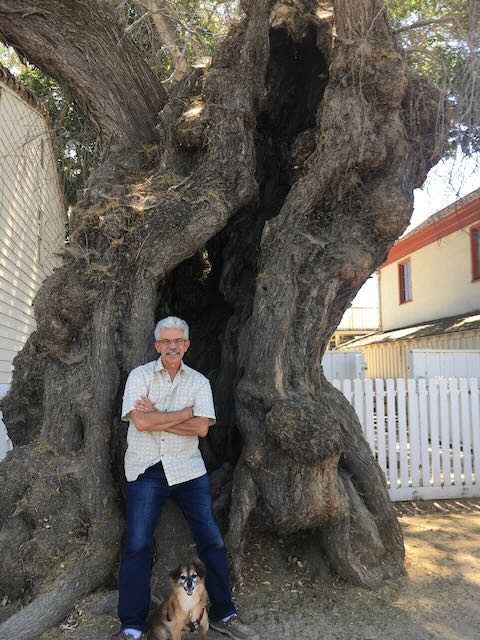
These two modern day banditos drove all the way down to the Bitterwater grade without committing a major crime along the way, other than the crime of compromise in taking Route 101 back up. We could have gone further south, but that will have to be another ride someday. However, this story is not done. There is Mission San Juan Bautista to talk about, a Spanish Mission and village still outside the Bay Area bubble; just a few streets of modest homes and a small commercial area of authentic Mexican food, antique shops, cold beer, bars and a few artists. The original Spanish settlers built the home of their faith literally right on the San Andreas fault. Somewhat ironic that faith is built on faults. But you know what? The earth underneath the home of their faith has moved many times in 300 years and the symbol of their faith still stands. The saplings of pepper trees they planted loom large and line the streets of mission area. I brought my father here many years ago. I have a picture him holding my then young son standing inside a hollow one enormous pepper tree. I have come here many times since; always taking time to honor the tree, what it knows about time and teaches about surviving when the fault lines of life move.
Like I said at the beginning, all of this happened three years ago, but thoughts of Tiburcio kept coming back. The story was missing something to make it fly right. The tale needed a tail. Enter Zorro.
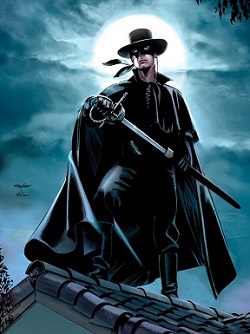
Tiburcio did not really die at the end of a rope. His legend lives on as does the others of his like. In 1920, a pulp fiction writer by the name of Johnston McCulley created the heroic character of “El Zorro”, the fox! He modeled Zorro in part after Tiburcio and Salomon Pico, who also was from Mission San Juan Baustista. McCulley erased their story of indignation and humiliation of displacement, hangings and rape of family members at the hands of Anglos. Instead, El Zorro was portrayed as a man of wealth and position who took up the cause as defender of the oppressed motivated by honor and moral high ground. McCulley further whitewashed their reputations by making the offending antagonists the rich Mexican autocracy, or worse yet, the Spaniards. The popularity of the Zorro story helped by the fact that America had just finished fighting the Spanish-America war a few years prior. Spain was reviled at the time. Lastly, McCulley may have left out the parts of all the robbing and shooting of sheriffs, however he still dallied with the loving of women. Some stories are a constant in history in seems.
The story of Zorro became embraced by all of America when Douglas Fairbanks starred in the 1920 hit “The Mark of Zorro”. For the rest of the century numerous new stories were written and produced on film by other actors and eventually television. I can’t say if McCulley did it on purpose, but in that dark time between the 19th and 20thcenturies when the world embraced imperialism and when “Might made Right” he planted the idea in the minds of Americans that the oppressed had rights too. I would like to think that McCulley had unconsciously become the conduit of Tiburcio’s soul and the grace of saint Tiburtius.
By the 1950’s Walt Disney took up the story of Zorro and brought it to the medium of television. One impressionable five-year-old was mesmerized each week by the flickering black and white images that brought forth sunny old California into dark of his parents’ modest apartment. In the Disney version of Zorro, the man is outwardly timid and often dismissed by those more powerful, but at night his inner strength emerges and as ventures out with his gallant steed Tornado. In his mind the little boy could see it all in color, the golden hills, the deep blue sky, the flickering orange of lanterns in halls of the Spanish missions. He could see himself as his hero vanquishing the evil doers each week. So taken with his hero that on the first day of kindergarten, when asked his name by the teacher, he shouted “Zorro” and flashed her an invisible Z with his finger.
Now I know why that day three years ago has stuck in mind for so long and why this story had laid unfinished. Unknown in the conscience mind of that sixty-five-year-old was the five-year-old, loving the golden hills and the deep blue sky. That wasn’t a Jag he was driving. That was his powerful jet-black steed, Tornado. That wasn’t Aneko sitting next to him, that was Bernardo, his silent loyal servant. Likewise unknown in the mind of the five-year-old was Tiburcio whispering to him “bienvenido de vuelta a casa mi hijo”, welcome back home my son. Now, three years later, the sixty-eight-year-old can see the fault lines too in the challenging of “evil doers” both real and imagined over the years. It is time to whisper back to Tiburcio, ” it is ok”. Fault lines move us from one place to another whether we like it or not. What is important is to keep the faith that good is stronger than evil.
Now my paper airplane is ready to fly long and straight. Thank you for reading.
 Let Me Tell You a Story